
Detailed 3D Dental Scans at Southern Smiles

A flat X-ray can tell your dentist a lot, but it can’t show everything. Teeth overlap on film, bone depth is hard to judge, and the nerves and sinuses that sit close to your roots can stay hidden behind other structures. At Southern Smiles, we use cone beam 3D imaging to see your teeth, jaw, and surrounding anatomy in three dimensions, which helps us plan treatment with greater accuracy and fewer surprises. Our Jacksonville dental office welcomes patients from across the area, including Orange Park, St. Augustine, and Jacksonville Beach. To find out whether a 3D scan makes sense for your care, call us at 904-389-3451.
What Is Cone Beam 3D Imaging?
Cone beam 3D imaging, also called cone beam computed tomography (CBCT), is a dental imaging method that uses a cone-shaped X-ray beam rotating once around your head to capture hundreds of images, which software then combines into a detailed three-dimensional model of your teeth, jawbone, nerve pathways, sinuses, and airway.
Why Jacksonville Patients Choose Southern Smiles
Southern Smiles is a privately owned practice on Oak Street in Jacksonville’s Riverside area, where Dr. Bethany Burton and Dr. Linda Trotter provide care for patients of all ages. Dr. Burton earned her Doctor of Dental Medicine degree in 2018 and completed hospital-based training at Miami Valley Hospital, which prepared her to treat a wide range of patients in a calm, safe setting. Having 3D imaging in our office means many patients can get scanned, diagnosed, and walked through their treatment plan in one place, without a separate trip to an imaging center.
Learn more about Dr. Burton and explore our other dental technology, including iTero digital impressions.
How Cone Beam 3D Imaging Differs from Traditional X-rays
Traditional dental X-rays remain the go-to tool for routine checkups. Their main limitation is that they compress three-dimensional structures into two dimensions, so one tooth can hide another, and measurements of bone height or width are only estimates.
A cone beam scan fills in those gaps. Here’s how the two compare:
- Image Type: Standard X-rays produce flat 2D images, while CBCT creates a 3D model you can view from every direction.
- Measurements: CBCT allows precise measurement of bone height, width, and density, which a 2D image can only approximate.
- Hidden Structures: CBCT shows the exact position of nerves, sinuses, and impacted teeth in relation to each other.
- Radiation Dose: A CBCT scan uses more radiation than a set of bitewing X-rays but significantly less than a conventional medical CT scan.
- Typical Use: X-rays handle routine screening, and CBCT is reserved for specific diagnostic and planning needs.
Because each tool has its strengths, we use 3D imaging alongside regular X-rays rather than in place of them, saving it for cases that need more detail.
How Cone Beam 3D Imaging Works
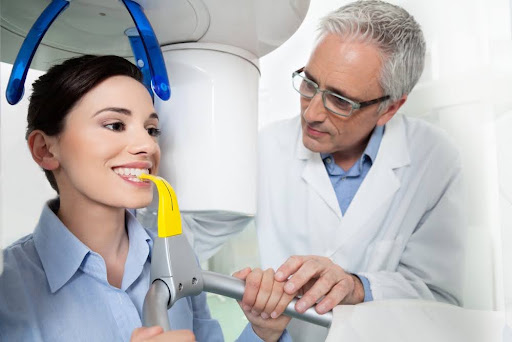
The scan itself is quick and straightforward, and most patients are surprised by how little they have to do. A typical appointment follows these steps:
1. Preparation: You’ll remove glasses, earrings, removable dental appliances, and other metal items that could distort the image.
2. Positioning: You’ll sit or stand in the scanner while a team member positions your head and may ask you to bite gently on a small guide.
3. Scanning: The arm of the machine makes a single rotation around your head, usually in under a minute, while you stay still.
4. Reconstruction: Software assembles the captured images into a 3D model within minutes.
5. Review: Your dentist examines the model, takes measurements, and walks you through what the scan shows.
There are no needles, no enclosed tube, and no recovery time, so you can return to your normal routine right after the appointment.
Types of Cone Beam Scans
Not every scan needs to capture your entire head. Dentists adjust the “field of view,” or the size of the area being imaged, so the scan covers only what’s needed for diagnosis. Common categories include:
- Small Field of View: Focuses on one tooth or a small group of teeth, often used for root canal evaluations, cracked teeth, or infections at the tip of a root.
- Medium Field of View: Covers one or both dental arches, which is useful for planning implants, evaluating impacted teeth, or assessing bone loss.
- Large Field of View: Captures the jaws, jaw joints, sinuses, and airway together, which helps with TMJ evaluations, orthodontic planning, and complex restorative cases.
Benefits of Cone Beam 3D Imaging
The real value of a 3D scan shows up in the treatment that follows. When your dentist can see the exact shape of your bone and the precise location of nearby nerves, treatment becomes more predictable and more comfortable. Benefits include:
- Accurate Treatment Planning: Surgeons and restorative dentists can map out procedures before the first appointment.
- Safer Implant Placement: Precise measurements help avoid nerves and sinuses during implant surgery.
- Earlier Detection: Cysts, infections, and bone changes that hide on 2D images may become visible.
- Clearer Patient Education: Seeing a 3D model of your own mouth makes it easier to understand your diagnosis and options.
- Fewer Surprises: A detailed picture of your anatomy reduces the chance of unexpected findings mid-procedure.
- Quick, Comfortable Scans: The process is noninvasive and typically takes less than a minute of scanning time.
Have questions about your situation? Call 904-389-3451 to schedule a consultation at our Jacksonville office.
When Is Cone Beam 3D Imaging Recommended?
Your dentist will recommend a CBCT scan when the answer to a clinical question depends on information a regular X-ray can’t provide. You may be a good candidate for a 3D scan if you need:
- Dental Implant Planning: Measuring bone volume and locating nerves before placing dental implants
- Wisdom Tooth Evaluation: Assessing how close impacted wisdom teeth sit to the nerve in the lower jaw
- Complex Extractions: Planning the safest approach for a difficult tooth extraction
- Bone Grafting: Determining whether you need bone grafting before an implant and how much
- Jaw Joint Concerns: Evaluating the bony structures involved in TMJ/TMD treatment
- Root Canal Challenges: Locating extra canals, hidden fractures, or persistent infections
- Dental Trauma: Checking for fractures of the teeth or jaw after an injury
- Full Mouth Restoration: Gathering detailed records for a full mouth reconstruction
Patients who only need routine cleanings and checkups typically don’t need cone beam imaging. Your dentist weighs the diagnostic benefit against the radiation exposure for every scan, so a recommendation for CBCT always has a clear purpose behind it.
Is Cone Beam 3D Imaging Safe?
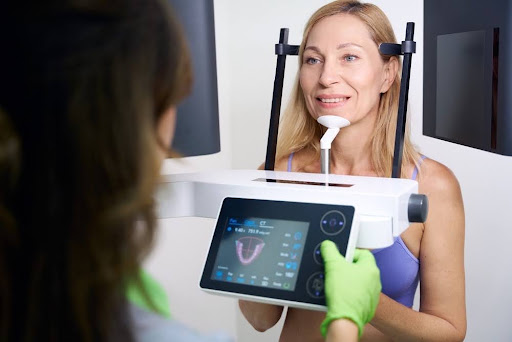
Cone beam imaging is considered safe for most patients when used appropriately. The radiation dose varies with the size of the scan, but even a larger dental CBCT scan generally exposes you to far less radiation than a hospital CT scan of the head. Smaller, focused scans deliver doses closer to a few days of natural background radiation, the kind everyone absorbs from the environment.
Like any imaging that uses X-rays, CBCT follows the principle of keeping exposure “as low as reasonably achievable.” In practice, that means we only order a scan when it will meaningfully improve your diagnosis or treatment, and we limit the field of view to the area that matters. If you’re pregnant or think you might be, let us know before your appointment so your dentist can decide whether the scan can wait.
Frequently Asked Questions
How long does a cone beam scan take?
The scanning itself usually takes less than a minute, and the full appointment, including positioning, is often done in about 10 to 15 minutes. Software builds the 3D model within moments, so there’s no waiting days for results. In many cases, your dentist can review the images with you during the same visit.
Does a cone beam scan hurt?
No, the scan is completely noninvasive. You simply sit or stand still while the machine rotates around your head, and nothing enters your mouth except, in some cases, a small bite guide. Unlike a medical CT or MRI, you won’t be placed inside an enclosed tube, which many patients with claustrophobia appreciate.
How much does cone beam 3D imaging cost?
Across the United States, a dental CBCT scan typically costs between $100 and $600, depending on the size of the scan and the region. Some dental insurance plans cover CBCT when it’s medically necessary, such as before implant surgery or a complex extraction, while others don’t. Medical insurance may also apply in certain cases involving trauma or oral surgery. Our team can review your coverage with you and discuss payment plans or our in-house membership plan before your scan.
Is cone beam imaging safe for children?
Yes, CBCT can be used for children when the benefit justifies it, for example, to locate an impacted canine or plan orthodontic care. Because children are more sensitive to radiation than adults, dentists are especially careful to use the smallest field of view and lowest settings possible. Your dentist will explain why a scan is recommended and what it will help determine.
Will I need a cone beam scan at every dental visit?
No, cone beam imaging isn’t part of routine checkups. Most patients only need a 3D scan when planning a specific procedure or investigating a problem that standard X-rays can’t fully explain. For regular preventive visits, traditional digital X-rays usually provide all the information your dentist needs.
Schedule Cone Beam 3D Imaging in Jacksonville
Whether you’re planning dental implants, dealing with a stubborn wisdom tooth, or looking for answers about jaw pain, a 3D scan can give you and your dentist a clearer path forward. Southern Smiles proudly serves Jacksonville and welcomes patients from Orange Park, St. Augustine, and Jacksonville Beach. Call 904-389-3451 or contact our Jacksonville dental office to schedule your visit today.


